Best Car Chargers UK 2026
Keep your phone, tablet, and laptop charged on every journey. Compare the best USB-C PD car chargers for iPhone, Samsung Galaxy, and MacBook — from 30W compacts to 160W powerhouses. All with free UK delivery.
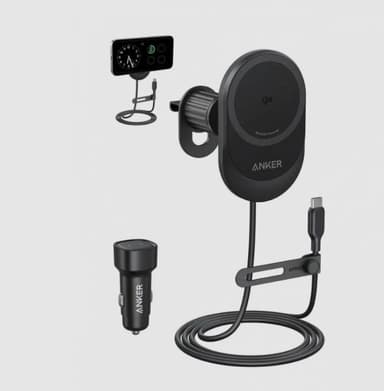
Anker MagGo 15W Wireless Charger Pad
With built-in USB-C cable & car adapter
Most car chargers leave you hunting for a cable. This one ships with the car adapter and a built-in USB-C cable, then drops your phone onto a 15W magnetic pad at the right viewing angle — so it charges while you navigate, with nothing loose in the footwell.
- 15W magnetic wireless charging
- Car adapter included in the box
- Built-in USB-C cable — nothing to lose
- Angled pad — see your screen while driving
20–130 W
Car charger wattage range
From basic USB-A to laptop-grade USB-C PD
~30 min
0–50 % iPhone charge time
With a 30W+ USB-C PD car charger
From £10
Quality car charger price
UGREEN, Baseus & Anker — free UK delivery
4-in-1
Safety protections standard
OVP, OCP, OTP & short-circuit on all picks
Car Charger Speed Comparison
How fast can different car charger types actually charge your devices? Here's a real-world comparison for 0–100% charge times.
| Charger Type | Wattage | iPhone 16 | Samsung S25 | Laptop |
|---|---|---|---|---|
| USB-A 5V/2.4A (basic) | 12W | ~2 h 30 min | ~2 h 45 min | ❌ No |
| USB-A QC 3.0 | 18W | ~2 h 00 min | ~1 h 40 min | ❌ No |
| USB-C PD 20W | 20W | ~1 h 30 min | ~1 h 35 min | ❌ No |
| USB-C PD 30W | 30W | ~1 h 20 min | ~1 h 10 min | ⚠️ Slow |
| USB-C PD + PPS 45W | 45W | ~1 h 20 min | ~55 min | ✅ Ultrabooks |
| USB-C PD 65–130W | 65–130W | ~1 h 20 min | ~55 min | ✅ All laptops |
Times are approximate for 0–100% charge. iPhone capped at 27W; Samsung capped at 25W (PPS). Laptop times vary by model.
How Car Charger Fast Charging Works
Your car's cigarette lighter socket provides 12V DC power. Here's how modern car chargers convert that into fast charging for your devices.
From 12V Socket to USB-C PD
Your car's 12V cigarette lighter socket (officially called the "auxiliary power outlet") delivers raw 12–14V DC power from the car's electrical system. A car charger contains a DC-DC converter that steps this down (or up) to the precise voltage your device needs. USB-C PD car chargers negotiate the optimal voltage and current with your device automatically — just like a wall charger, but powered by your car instead of the mains.
The cigarette lighter socket is typically fused at 10–15 amps (120–180W at 12V), which is why the most powerful car chargers top out at around 130–160W. This is more than enough to charge a laptop and a phone simultaneously.
USB-C PD (Power Delivery)
The universal fast-charging standard. Supports 5V, 9V, 12V, 15V, and 20V output at various current levels. Works with every modern device: iPhone, Samsung, Pixel, iPad, MacBook, Dell, ThinkPad. The only protocol that supports laptop charging.
PPS (Programmable Power Supply)
An extension of USB-C PD that allows fine-grained voltage adjustments in 20mV steps. Required by Samsung for 25W Super Fast Charging. Without PPS, Samsung phones fall back to 15W. Most premium car chargers include PPS.
QC 3.0 / 4.0 (Quick Charge)
Qualcomm's proprietary fast-charging standard, mainly used over USB-A ports. QC 3.0 delivers up to 18W. QC 4.0+ is essentially USB-C PD compatible. Being phased out in favour of PD, but still useful for USB-A ports on older devices.
Best Car Chargers 2026 — Our Top 5 Picks
Expert-tested and rated. The best USB-C car chargers for UK drivers, whether you're charging a phone, a laptop, or both.
UGREEN 130W Dual USB-C Car Charger
Best overall — phones + laptops
The best all-round car charger in 2026. Dual USB-C ports deliver 100W + 30W simultaneously — fast-charge your laptop and phone at the same time. Supports PD 3.0, QC 4.0, and PPS for Samsung 25W Super Fast Charging. Compact aluminium body stays cool under load.
- 130W total (100W + 30W USB-C)
- PD 3.0, QC 4.0, PPS, Apple 2.4A
- Charges MacBook Pro + iPhone at once
- Aluminium body with LED indicator
Baseus 160W USB-C Car Charger
Best for power users & families
The most powerful car charger available. Triple-port design (2× USB-C + 1× USB-A) with 160W total output. The primary USB-C port delivers 100W for laptops while secondary ports handle phones and tablets. Built-in digital display shows real-time voltage and current.
- 160W total (100W + 30W + 30W)
- 3 ports: 2× USB-C + 1× USB-A
- Digital LED voltage display
- PD 3.0, PPS, QC 5.0, SCP
UGREEN 69W USB-C Car Charger
Best budget dual-port charger
Exceptional value at under £16. Dual-port (USB-C PD + USB-A QC) design handles your phone and a passenger's device. 45W USB-C port fast-charges any phone and slowly charges a MacBook Air. Compact flush-fit design barely protrudes from the cigarette lighter socket.
- 69W total (45W USB-C + 24W USB-A)
- PD 3.0 + QC 3.0
- Flush-fit compact design
- Samsung 25W Super Fast Charging
Anker 535 67W Car Charger
Best for iPhone users
Anker's flagship car charger with PowerIQ 4.0 technology that automatically detects and delivers optimal charging for every device. Dual USB-C ports with dynamic power allocation — 67W single-port or 40W + 27W dual-port. Sleek matte finish with subtle LED.
- 67W total (dynamic allocation)
- Dual USB-C with PowerIQ 4.0
- iPhone optimised charging
- ActiveShield 2.0 temp monitoring
Baseus 65W USB-C Car Charger
Best compact car charger
The smallest 65W car charger on the market — barely visible when plugged in. Dual-port (USB-C + USB-A) with 65W PD on the USB-C port. Perfect for drivers who want fast charging without a bulky plug sticking out of the dashboard. Aluminium alloy dissipates heat efficiently.
- 65W USB-C PD + 30W USB-A
- Ultra-mini flush-fit design
- Aluminium alloy heat sink
- PD 3.0, PPS, QC 3.0
Types of Car Chargers
From USB-C PD powerhouses to wireless car mounts — here's every type of car charger you can buy in 2026 and when each makes sense.
USB-C PD Car Chargers
The modern standard. Plug into your cigarette lighter socket and get 20–130W USB-C Power Delivery. Fast-charges iPhones, Samsung Galaxy, Pixel, iPads, and even laptops. The only type worth buying in 2026.
- USB-C Power Delivery
- 20–130W output
- iPhone + Samsung + laptop
- Universal fast charging
Dual/Triple-Port Car Chargers
Multi-port car chargers with 2–3 USB ports (USB-C + USB-A mix). Charge your phone and your passenger's device simultaneously. Premium models deliver 100W+ total, with smart power allocation between ports.
- 2–3 ports
- 65–160W total
- Charge multiple devices
- USB-C + USB-A combo
Wireless Car Mount Chargers
Mount your phone on the dashboard or air vent and charge wirelessly while driving. MagSafe-compatible models snap iPhones magnetically. Qi2 and standard Qi options available. Typically 7.5–15W.
- MagSafe / Qi2 / Qi
- 7.5–15W wireless
- Dashboard or vent mount
- One-hand phone mounting
USB-A Car Chargers (Legacy)
Older-style car chargers with USB-A ports only. Limited to 12–18W (Quick Charge 3.0). Still functional for basic charging but 2–3× slower than USB-C PD for modern smartphones. Being phased out in favour of USB-C.
- USB-A ports
- 12–18W max
- QC 3.0 support
- Budget option
Wired vs Wireless Car Chargers
Should you go with a wired USB-C car charger or a wireless car mount? Here's how they compare.
| Feature | Wired USB-C | Wireless Mount |
|---|---|---|
| Max charging speed | 27–130W | 7.5–15W |
| iPhone 16 charge time (0–50%) | ~30 minutes | ~45–60 minutes |
| Hands-free mounting | Separate mount needed | Built-in mount |
| Navigation visibility | Phone in pocket/cup holder | Phone on dashboard |
| Laptop charging | ✅ 45W+ models | ❌ Not possible |
| Price range | £10–£30 | £20–£50 |
| Cable management | Cable required | Cable-free to phone |
| Heat generation | Low | Moderate |
| Best for | Maximum speed & laptops | Convenience & navigation |
Choose Wired If…
- You want the fastest possible charging speed
- You need to charge a laptop in the car
- You want to spend under £20
- You carry an Android phone without MagSafe
Choose Wireless If…
- You use your phone for sat-nav while driving
- You have an iPhone with MagSafe (magnetic snap)
- You prefer a clean, cable-free dashboard
- Charging speed isn't your top priority
Car Charger Compatibility by Device
What wattage and cable does your device need? Find your phone, tablet, or laptop below.
| Device | Max Wattage | Protocol | Car Charger Needed | Cable |
|---|---|---|---|---|
| iPhone 16 / 16 Pro Max | 27W | USB-C PD | 30W+ USB-C PD | USB-C to USB-C |
| iPhone 15 / 15 Pro | 27W | USB-C PD | 30W+ USB-C PD | USB-C to USB-C |
| iPhone 14 / 13 / SE | 20W | USB-C PD | 20W+ USB-C PD | USB-C to Lightning |
| Samsung Galaxy S25 / S24 | 25W | USB-C PD + PPS | 25W+ PD + PPS | USB-C to USB-C (3A) |
| Samsung Galaxy A-series | 15–25W | USB-C PD / AFC | 25W+ PD + PPS | USB-C to USB-C |
| Google Pixel 9 / 8 | 27–30W | USB-C PD | 30W+ USB-C PD | USB-C to USB-C |
| iPad Pro / Air (USB-C) | 30–35W | USB-C PD | 30W+ USB-C PD | USB-C to USB-C |
| MacBook Air 13″ | 30–67W | USB-C PD | 45W+ USB-C PD | USB-C to USB-C (60W rated) |
| MacBook Pro 14″ | 67–96W | USB-C PD | 65W+ USB-C PD | USB-C to USB-C (100W rated) |
| Dell XPS / ThinkPad | 45–100W | USB-C PD | 65W+ USB-C PD | USB-C to USB-C (100W rated) |
| Nintendo Switch | 18W | USB-C PD | 30W+ USB-C PD | USB-C to USB-C |
| Steam Deck | 45W | USB-C PD | 45W+ USB-C PD | USB-C to USB-C |
Pro tip: A 65W dual USB-C car charger covers every device in this table except power-hungry 15–16" gaming laptops. It's the sweet spot for most UK drivers who need to charge a phone and occasionally a laptop.
Car Charger Safety: What to Look For
A car's electrical system is less stable than mains power — engine starts cause voltage spikes, and summer heat tests thermal limits. Here are the safety features every quality car charger should have.
Over-Voltage Protection (OVP)
Cuts power if voltage exceeds safe levels, protecting your device from power surges when starting the engine.
Over-Current Protection (OCP)
Limits current draw to safe levels, preventing overheating and cable damage.
Over-Temperature Protection (OTP)
Monitors internal temperature and throttles output if the charger gets too hot — especially important in summer.
Short-Circuit Protection
Instantly cuts power if a short circuit is detected, preventing damage to both the charger and your car's electrical system.
UKCA / CE Certification
Legal requirement for electronics sold in the UK. Confirms the charger meets British safety, health, and environmental standards.
Smart Power Allocation
Dynamically distributes wattage between ports based on connected devices, ensuring each device gets optimal charging speed.
Engine Start Voltage Spikes
When you start your car, the voltage in the cigarette lighter socket can momentarily spike to 16V+ or dip below 9V as the starter motor draws massive current. Quality car chargers have surge protection that absorbs these spikes. Cheap unbranded chargers may not — and in rare cases, a voltage spike can damage a connected device. This is the #1 reason to avoid ultra-cheap unbranded car chargers. Every pick in our top 5 above includes full surge protection.
How to Choose the Right Car Charger
Follow these 6 steps to find the perfect car charger for your setup.
Identify your devices
List every device you'll charge in the car. Phone only? Phone + passenger's phone? Phone + laptop? This determines the wattage and port count you need.
Choose the right wattage
Phone only: 30W is plenty. Two phones: 45W dual-port. Phone + laptop: 65W minimum (100W+ recommended). Don't overspend on wattage you'll never use.
Check protocol support
iPhone needs USB-C PD. Samsung needs PD + PPS for 25W Super Fast Charging. Most quality chargers support all protocols, but always verify before buying.
Consider the form factor
Flush-fit designs sit nearly flat in the cigarette lighter socket — ideal for clean dashboards. Larger chargers protrude more but often have more ports and higher wattage.
Don't forget the cable
Your car charger is only as fast as your cable. For phones, a 60W-rated USB-C cable is fine. For laptops, you need a 100W E-marked cable. Buy a 0.5–1m cable to avoid dashboard clutter.
Verify safety certifications
Look for UKCA or CE marking, plus built-in protections (OVP, OCP, OTP, short-circuit). Aluminium-body chargers dissipate heat better than plastic ones.
5 Common Car Charger Mistakes
Avoid these pitfalls when buying a car charger — they cost you speed, safety, or money.
Buying USB-A only in 2026
Problem: USB-A car chargers cap out at 12–18W — painfully slow for modern phones that accept 25–30W.
Fix: Choose a car charger with at least one USB-C PD port. Prices start from just £10.
Using unbranded ultra-cheap chargers
Problem: No-name car chargers often lack safety protections and can deliver unstable voltage, risking damage to your phone.
Fix: Stick with UGREEN, Baseus, or Anker. Their budget models (£10–£16) include full safety protections.
Ignoring the cable quality
Problem: A 130W car charger is only as fast as its weakest link — a cheap £2 cable may only handle 15W.
Fix: Use a cable rated for your charger's wattage: 60W cables for phones, 100W cables for laptops. E-marked cables are best.
Getting too many watts for phone-only use
Problem: A 130W car charger is overkill if you only charge one phone — and costs 2× more than you need.
Fix: For phone-only charging, a 30–45W dual-port car charger is the sweet spot — fast, compact, and under £16.
Forgetting PPS for Samsung devices
Problem: Samsung Galaxy phones need PPS (Programmable Power Supply) for 25W Super Fast Charging. Without PPS, they top out at 15W.
Fix: Check the spec sheet for "PPS" support. UGREEN and Baseus car chargers above 45W almost always include PPS.
Cigarette Lighter Charger vs Built-In Car USB
Many modern cars have built-in USB ports. Are they good enough, or do you still need a dedicated car charger?
Cigarette Lighter Car Charger
- 20–160W output — fast charges any device including laptops
- USB-C PD support — proper fast-charging protocols for modern phones
- Upgradeable — swap for a newer model as technology improves
- Works in any car — virtually all cars have a 12V socket
Built-In Car USB Ports
- Typically 2.5–5W only — barely maintains battery, let alone fast-charges
- USB-A only on most cars — no USB-C PD, no fast charging support
- Designed for data, not power — car USB ports prioritise Apple CarPlay / Android Auto
- Exception: Some 2024+ cars have USB-C PD ports at 15–27W — check your manual
Our recommendation: Even if your car has built-in USB ports, a dedicated cigarette lighter car charger is worth the £10–£25 investment. You'll get 5–10× faster charging and the ability to charge laptops. Use the built-in port for CarPlay/Android Auto data, and the car charger for actual power.
Car Charging Tips for Long Journeys
Heading on a road trip? Here's how to keep every device charged for hours on the motorway.
Bring a Power Bank as Backup
A 10,000–20,000mAh power bank lets passengers charge in the back seat without running cables from the front. Charge the power bank via the car charger during the first leg of the journey, then use it cable-free for the rest.
Use Short Cables (0.5–1m)
Long cables tangle around the gear stick, handbrake, and cup holders. A 0.5–1 metre USB-C cable is perfect for front-seat charging — long enough to reach your phone mount, short enough to keep the cabin tidy.
Multi-Port for Families
A family of four needs at least 2–3 charging ports. The Baseus 160W triple-port car charger (2× USB-C + 1× USB-A) handles three devices at once. Pair with a rear-seat cable extension or portable charger for back-seat passengers.
Laptop Charging on the Go
Need to work from the passenger seat? A 100W+ car charger can charge your laptop at near-wall-charger speeds. Use a 100W E-marked USB-C cable and enable your laptop's battery-saver mode for the most efficient charging.
Car Chargers in Electric vs Petrol Cars
Does it matter whether you drive an EV or a petrol car? Here's what you need to know.
Electric & Hybrid Cars
Most EVs and hybrids (Tesla, BMW i-series, VW ID range, Hyundai Ioniq) still include at least one 12V accessory socket — your cigarette lighter car charger works exactly the same way. Some newer EVs also have high-power USB-C ports built into the centre console (15–27W), which is better than the typical 5W USB-A port in petrol cars.
Tesla note: Tesla Model 3 and Model Y have built-in 36W USB-C ports in the centre console — fast enough for phone charging without any accessories. However, the front ports are shared with dashcam recording, so a dedicated car charger in the 12V socket is still useful.
Petrol & Diesel Cars
All petrol and diesel cars have a 12V cigarette lighter socket (some have 2–3 throughout the cabin). This is the standard way to use a car charger. The socket is powered by the car's 12V lead-acid battery and recharged by the alternator when the engine runs.
Built-in USB ports in petrol/diesel cars (pre-2024) are almost universally slow — typically 2.5W USB-A, designed for Apple CarPlay / Android Auto data transfer rather than charging. A dedicated car charger in the 12V socket is essential for fast charging.
Car Charger FAQs
Answers to the most common questions about car chargers, fast charging in vehicles, and device compatibility.
What is the best car charger for iPhone in the UK?
Can I charge my laptop with a car charger?
What wattage car charger do I need?
Are USB-C car chargers safe to use?
Do car chargers drain the car battery?
What is the difference between PD and QC car chargers?
Can I use a car charger while the engine is off?
Do I need a USB-C car charger or is USB-A enough?
What is the fastest car charger for Samsung Galaxy?
Can a car charger damage my phone?
Continue Exploring
Charge Faster on Every Journey
Upgrade from your car's slow built-in USB. Our top-rated USB-C PD car chargers deliver laptop-grade power from your cigarette lighter — from just £10 with free UK delivery.