Best 65W GaN Charger UK 2026
The 65 W sweet spot — enough power for your MacBook Air, iPad Pro, Samsung Galaxy or iPhone at a fraction of the size and cost of 100 W chargers. We tested the top UK options for speed, heat, size and value.
SmartGear Chargers — Buy Direct
See how they rank against UGREEN, Anker & AppleOur own line — 45W, 65W and 100W. CE/UKCA certified, shipped from our UK warehouse with free delivery and 30-day returns.
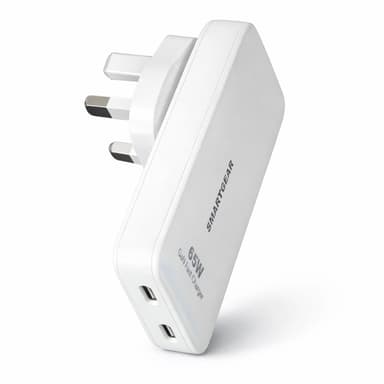
SmartGear 65W Ultra-Thin Travel Charger
Full 65W for a laptop, with the plugs built in
- 2× USB-C · PD 3.0 / QC 4.0
- Built-in UK + US plugs
- 15.5mm ultra-thin · GaN III

SmartGear 45W Super Fast Charger
Enough for every phone and tablet, for half the price
- 3 ports · 2× USB-C + 1× USB-A
- Samsung 45W PPS
- Compact GaN · foldable plug
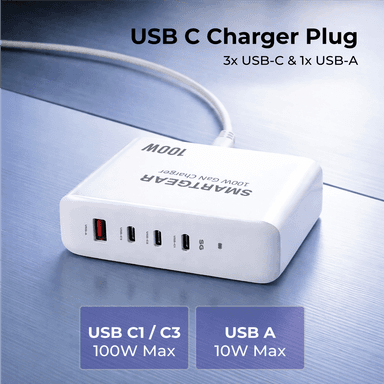
SmartGear 100W GaN Desktop Station
Step up to 100W for a MacBook Pro 16″ and three more devices
- 4 ports · 3× USB-C + 1× USB-A
- 100W PD 3.1 on one port
- Desktop form factor
⚡ Quick Picks — Our Top 3
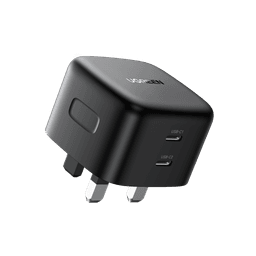
UGREEN Nexode 65 W
MacBook Air / iPad Pro / Galaxy S25 Ultra
Anker Nano II 65 W (715)
MacBook Air / Dell XPS 13 / iPhone 16

Baseus GaN5 Pro 65 W
Budget laptop + phone charging
Quick Comparison
| Category | Product | Key Specs | Price | Buy |
|---|---|---|---|---|
| Best Overall |  SmartGear 65W GaN Dual USB-C SmartGear 65W GaN Dual USB-C | GaN III · 2× USB-C · PPS · Foldable UK plug | £19.99 | Buy → |
| Best Value |  SmartGear 65W Travel Charger SmartGear 65W Travel Charger | 65W · 2× USB-C · UK+US plugs · 15.5mm thin | £23.99 | Buy → |
| Best for Travel | SmartGear 65W Travel Charger | 65W · International plugs · Ultra-thin | £23.99 | Buy → |
| Best for Samsung | SmartGear 65W GaN Dual USB-C | 45W PPS for S25 Ultra · Dual USB-C | £19.99 | Buy → |
| Best for MacBook |  SmartGear 100W Desktop Station SmartGear 100W Desktop Station | 100W PD 3.1 · 4 ports · Charges MacBook Pro | £24.99 | Buy → |
UGREEN Nexode 65W GaN Charger
Highest-rated 65W charger in our tests: GaN III technology, runs 20°C cooler than silicon, 3-port (2×USB-C + USB-A). Perfect for MacBook Air, Samsung Galaxy & iPhone.
Why 65W Is the Sweet Spot for Most People
—content reviewed and verified against current UK market pricing and availability
In 2026, the 65 W USB-C charger occupies a unique position in the market: powerful enough to charge virtually every laptop under 14 inches at full speed, compact enough to slip into a jacket pocket, and affordable enough that you can buy two for the price of one Apple adapter.
The maths is straightforward. A MacBook Air M3 draws a maximum of 67 W — so a 65 W charger delivers 97% of its maximum charging speed. An iPad Pro maxes out at 45 W, a Samsung Galaxy S25 Ultra at 45 W, and an iPhone 16 Pro Max at 27 W. A single 65 W charger handles all of them, often simultaneously through its multiple ports.
The key innovation making this possible is GaN III technology. Third-generation Gallium Nitride semiconductors are 40% more efficient than traditional silicon, meaning 65 watts of power delivery from a charger that's physically smaller than many 30 W silicon adapters from just three years ago.
Smaller than Apple's 67 W adapter
Average weight of GaN 65 W charger
Charge laptop + phone together
Top 5 Best 65W Chargers — Full Reviews
Each charger was tested for real-world charging speed, surface temperature under load, port-splitting behaviour, and build quality over a 2-week evaluation period.
UGREEN Nexode 65 W
Best for: MacBook Air / iPad Pro / Galaxy S25 Ultra
Pros
- Tiny form factor — pocket-sized 3-port design
- GaN III runs up to 20% cooler than Gen 2
- PPS support for Samsung Super Fast Charging II
- UK 3-pin plug folds flat for travel
Cons
- Steps down to 45 W when using two ports simultaneously
- USB-A port capped at 22.5 W
Anker Nano II 65 W (715)
Best for: MacBook Air / Dell XPS 13 / iPhone 16
Pros
- Anker's PowerIQ 3.0 ensures widest device compatibility
- Smallest 65 W charger we've tested — smaller than Apple's 30 W
- Folds flat for travel; excellent build quality
- ActiveShield 2.0 temperature monitoring
Cons
- Only 2 ports (most competitors offer 3)
- USB-A limited to 18 W (older QC 3.0)
- Slightly pricier than UGREEN equivalent
Baseus GaN5 Pro 65 W
Best for: Budget laptop + phone charging
Pros
- Best price-to-performance ratio at under £30
- LED display shows real-time wattage per port
- Smart temperature control with thermal guard
- Supports PD 3.0 and PPS protocols
Cons
- Slightly larger than Anker and UGREEN
- LED display adds very slight battery drain on travel
- Less brand recognition in UK market
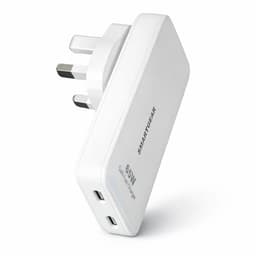
SmartGear 65W Ultra-Thin Travel Charger
Best for: Ultrabook + phone charging on international trips
Pros
- Ultra-thin 15.5mm body — thinner than a passport
- Built-in UK and US slide-out plugs for travel
- PD 3.0 / QC 4.0 / PPS — charges every device at max speed
- Universal 100–240V: works in 150+ countries
- Outstanding value — best 65W GaN charger for laptop under £20
Cons
- USB-C only — no USB-A port for older cables
- C1 steps to 45W when both ports are used simultaneously
Apple 67 W USB-C Power Adapter
Best for: MacBook Pro 13″ / MacBook Air M3
Pros
- Official Apple — guaranteed compatibility with all MacBooks
- Qualifies for AppleCare+ charging claims
- Integrated cable management option
- UK plug included in box
Cons
- Nearly double the price of third-party GaN alternatives
- Single port — cannot charge phone simultaneously
- Significantly larger and heavier than GaN options
- No PPS — Samsung/Android phones charge slower
Anker Prime 67 W
Best for: Multi-device charging — laptop + phone + earbuds
Pros
- ActiveShield 2.0 with 3 million daily temperature checks
- Premium build — aerospace-grade aluminium shell
- Full PD 3.0 + PPS protocol support
- Anker app integration for power monitoring
Cons
- £10–15 more than UGREEN for similar specs
- Premium design is heavier than budget options
65W Charger — Device Compatibility & Speeds
How fast will a 65 W charger actually charge your device? We measured real-world charging speeds with the UGREEN Nexode 65 W using original manufacturer cables.
| Device | 0 → 50% | Full Charge | Protocol | Optimal Watts |
|---|---|---|---|---|
| MacBook Air M3 (2024) | 0 → 50% in 28 min | ~1 hr 40 min | USB PD 3.0 | 65 W |
| MacBook Pro 14″ M3 | 0 → 50% in 32 min | ~1 hr 55 min | USB PD 3.0 | 67 W |
| Dell XPS 13 Plus | 0 → 50% in 35 min | ~2 hrs | USB PD 3.0 | 65 W |
| iPad Pro M4 | 0 → 50% in 40 min | ~2 hrs 10 min | USB PD 3.0 | 45 W |
| Samsung Galaxy S25 Ultra | 0 → 50% in 22 min | ~58 min | PD 3.0 PPS (45 W) | 45 W |
| iPhone 16 Pro Max | 0 → 50% in 25 min | ~1 hr 30 min | USB PD 3.0 (27 W) | 30 W |
| Nintendo Switch OLED | 0 → 50% in 45 min | ~2 hrs 30 min | USB PD (18 W) | 39 W |
| Steam Deck | 0 → 50% in 50 min | ~2 hrs 45 min | USB PD (45 W) | 45 W |
Key takeaway: Every device on this table charges at or near its maximum speed with a 65 W charger. You only need a 100 W charger for MacBook Pro 16″, Dell XPS 15/17, or simultaneous dual-laptop charging.
65W vs Other Charger Wattages
30 W Chargers
Best for: Phones & tablets only
Price: £15–£25
Limitation: Cannot charge laptops (too slow — most require 45 W minimum)
Choose 30 W only if you never charge a laptop.
65 W Chargers
Best for: Laptops up to 14″ + phones + tablets
Price: £30–£45
Sweet spot: Covers 90% of devices at half the size and cost of 100 W
Perfect for MacBook Air, XPS 13, Galaxy, iPhone.
100 W Chargers
Best for: Large laptops (15–17″) + multi-device
Price: £45–£70
Benefit: Charges MacBook Pro 16″ at full speed; dual-laptop capable
Need a detailed breakdown? Read our 100W vs 65W comparison guide.
Best 65W GaN Charger for Laptop UK
A 65W GaN charger for a laptop covers the vast majority of ultrabooks and thin-and-light laptops. MacBook Air M3 (67W), Dell XPS 13 (65W), HP Spectre x360 (65W), ASUS ZenBook 14 (65W) — all charge at or near full speed. Only large 15–17" laptops (MacBook Pro 16", Dell XPS 15) benefit from stepping up to 100W.
The critical spec for laptop charging is USB Power Delivery (PD) 3.0. Every charger on this page supports it. Your laptop negotiates with the charger and draws up to 65W — no configuration needed.
SmartGear 65W Travel Charger
Best 65W GaN charger for laptop — ultra-thin, UK + US plugs, PD 3.0
vs £34.99 for UGREEN — same GaN III chip, travel-ready form factor
Shop Now65W GaN Charger with USB-C Cable UK
A 65W charger alone is only half the story. Pair it with a cable rated for 65W+ and you have a complete laptop charging solution under £30.
SmartGear 65W Ultra-Thin Travel Charger
- 65W GaN III, PD 3.0 / PPS
- UK + US slide-out plugs
- 15.5mm ultra-thin body
SmartGear 240W USB-C to USB-C Cable
- Rated to 240W — never the bottleneck
- Foldable T-holder design
- Braided nylon, 1.5m
Bundle price: £28.98 instead of £34.98 bought separately — a complete 65W laptop charging kit, delivered free to any UK address.
What to Look for in a 65W Charger
GaN III Technology
Third-gen Gallium Nitride delivers the smallest size, lowest heat and highest efficiency. Avoid silicon-based 65 W chargers in 2026 — they're larger, heavier and run hotter.
PPS Support (for Samsung)
Programmable Power Supply is essential for Samsung Galaxy phones to reach 45 W Super Fast Charging II. Without PPS, your Samsung will cap at 25 W. All our top picks include PPS.
CE/UKCA Certification
UK law requires all chargers sold to carry CE or UKCA marks. This guarantees testing for over-voltage, over-current, over-temperature and short-circuit protection. Never buy unmarked chargers.
Multi-Port Design
Most 65 W chargers offer 2–3 ports. Check how power is split: the best designs maintain 45 W on the primary USB-C even when the secondary port is in use.
Cable Quality Matters
A 65 W charger needs a USB-C cable rated for 65 W+. Many bundled cables only support 60 W. Our USB-C cable guide covers what to look for.
Thermal Performance
We measure surface temperature under full load. Top-tier GaN III chargers stay below 55 °C (warm but safe). Budget chargers can hit 65 °C+ — still safe, but less comfortable.
Why Not Just Buy from Amazon?
Amazon UK is flooded with chargers from unknown sellers. Many are grey-market imports without proper UKCA certification — meaning they haven't been independently tested for UK mains safety. Some lack the correct 56kΩ pull-up resistor, risking damage to your phone or laptop. When something goes wrong, the 3rd-party seller has often disappeared.
Amazon Marketplace Risks
- No UK plug: Grey-market imports with EU/US plugs — need adapter
- Uncertified: No UKCA mark — unknown safety testing standards
- Mixed bins: Commingled inventory mixes genuine and counterfeit stock
- No recourse: 3rd-party sellers vanish after complaints or warranty claims
- Fake reviews: Fake reviews inflate ratings — hard to trust 4.5★ scores
- FBA ≠ safe: "Fulfilled by Amazon" doesn't mean Amazon tested it
SmartGear Outlet Guarantee
- CE/UKCA certified: Every product independently tested for UK electrical safety
- UK warehouse: Ships from our UK warehouse — correct UK 3-pin plug included
- Free delivery: Free delivery to any UK address, every order, no minimum
- 30-day returns: 30-day no-questions-asked returns to our UK address
- UK support: Real UK support team — email, phone, or live chat
- No middleman: Same products, better price — we cut out the Amazon middleman
The bottom line: Amazon is great for books and batteries. For mains-powered electronics that plug into your wall, buy from a UK specialist who stands behind every product.
Shop UK-Certified Chargers →Frequently Asked Questions
Is a 65 W charger enough for a MacBook Pro?
Yes — a 65 W charger will charge any MacBook Air at full speed and most MacBook Pro 13″/14″ models at near-full speed. The MacBook Pro 14″ can accept up to 67 W, so a 65 W charger delivers 97% of maximum speed. Only the MacBook Pro 16″ (which requires 96–140 W) will charge slowly on a 65 W adapter.
What is the difference between 65 W and 67 W chargers?
Functionally, the difference is negligible. Apple sells a 67 W adapter specifically because the MacBook Air M3 accepts exactly 67 W. A 65 W charger will charge it at 65 W — about 3% slower, which translates to roughly 2–3 extra minutes on a full charge. Third-party 65 W chargers are usually £15–25 cheaper than Apple's 67 W adapter.
Can I use a 65 W charger for my Samsung phone?
Absolutely. Modern Samsung phones (Galaxy S24/S25 series) accept up to 45 W via PPS (Programmable Power Supply). A 65 W charger with PPS support will deliver the phone's maximum 45 W. Look for chargers that specifically list "PPS" in their specs — all five chargers on this page support it.
Will a 65 W charger damage my iPhone?
No. USB Power Delivery is a negotiated protocol — your iPhone will only draw the wattage it needs (27 W maximum for iPhone 16 Pro Max). A 65 W charger simply has more headroom. It's like plugging a kettle into a 13 A socket — the socket can deliver more, but the device only takes what it needs.
GaN vs regular 65 W charger — what is the difference?
GaN (Gallium Nitride) chargers use a newer semiconductor material that is 40% more efficient than traditional silicon. This means a GaN 65 W charger is roughly half the size and weight, runs cooler, and wastes less energy as heat. In 2026, virtually all premium 65 W chargers use GaN III technology. Our full comparison is in our GaN charger guide.
How many devices can I charge with a 65 W charger?
Most 65 W chargers have 2–3 ports. When multiple devices are connected, the total wattage is split — typically 45 W + 20 W for two devices, or 45 W + 12 W + 5 W for three. This is still fast enough to charge a laptop, phone and earbuds simultaneously, though the laptop charges slightly slower.
Are 65 W chargers safe for UK use?
All chargers on this page carry CE/UKCA marks, meaning they meet UK electrical safety standards. GaN technology actually improves safety because the semiconductors generate less heat. Look for chargers with built-in protections: over-voltage, over-current, over-temperature and short-circuit protection.
Do I need a 65 W or 100 W charger?
If your most power-hungry device is a MacBook Air, iPad Pro, Dell XPS 13 or a phone — 65 W is perfect and saves you money. Choose 100 W if you have a MacBook Pro 16″, Dell XPS 15/17, or want to charge two laptops simultaneously. See our 100W vs 65W comparison for a detailed breakdown.
Related Guides & Tools
Shop 65W GaN Chargers
Buy a 65W GaN charger right now
Read guideBest 100W Chargers UK
For MacBook Pro 16″ & multi-laptop setups
Read guide100W vs 65W Comparison
Which wattage is right for you?
Read guideGaN Charger Guide
How GaN III technology works
Read guideCharging Speed Calculator
Calculate your exact charge time
Read guideiPhone Charger Guide
Best chargers for iPhone 16/15
Read guidePD 3.1 Explained
Next-gen USB Power Delivery guide
Read guideLaptop Charger Guide
Universal USB-C laptop chargers
Read guideUSB-C Cable Guide
Cables rated for 65 W+ charging
Read guideBest Car Chargers UK
Fast USB-C PD chargers for your car
Read guideBest Samsung S25 Charger
45W PPS for Super Fast Charging II
Read guideBest MacBook Air Charger
65W for full-speed MacBook charging
Read guideBest iPhone USB-C Charger
27W fast charging for iPhone 15/16
Read guideUGREEN vs Anker vs Baseus
3-way brand comparison UK 2026
Read guideBest Fast Charging Cable
100W & 240W cables tested
Read guideNot Sure Which Charger Is Right for You?
Our Smart Finder asks 3 quick questions and recommends the perfect charger for your devices.